Capital
City Arts Initiative
Nevada Neighbors
Laura Addison Essay
Traditions/Technologies: Contemporary Art Practices in New Mexico
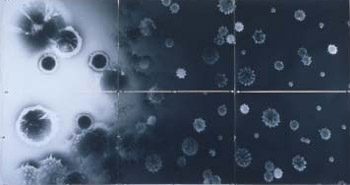
© Leigh Anne Langwell, Abyssal photogram |
page 2
Technologies
Since World War II, New Mexico has held a place in the history of
science and technology. It was in Los Alamos, an isolated town in
northern New Mexico, that Robert Oppenheimer and his team of scientists
created the atomic bomb in 1945. This group of scientists formed
the nucleus of a veritable "science colony," a group of like-minded
people coming together for a common purpose. Another such "colony"-an
art colony-had already existed in New Mexico since the 1910s. Thus
New Mexico became a nexus of art and science.
Science and art are often perceived as being at odds with each another: the former guided by logic, observation and calculation, the latter by intuition and emotion. Yet, in fact, many artists are indebted to the language and/or disciplined approach of science in the creation of their work. Contemporary society has increasingly looked within itself to unravel the inner workings and architecture of the human organism and, by extension, society at large. Visual artists are no exception.
Given the presence of Los Alamos and the Trinity Site, where the first atomic bomb was detonated in southern New Mexico, artists have long responded to New Mexico's place within the nuclear age. Meridel Rubenstein's collaborative body of work Critical Mass marked the 50th anniversary of the detonation of the atomic bomb. Portraits of Oppenheimer appear juxtaposed with missiles protruding from the landscape, as well as the landscape's features themselves, both natural and man-made. She frames New Mexico's nuclear legacy as an epic tale worthy of the Classics. Archimedes' Chamber consists of a tower of videos situated between multi-paneled photographs framed in a house- or missile-shaped format. By drawing a parallel between the Greek inventor Archimedes, who studied the principles of the lever and gravity, and the modern age's inventor of atomic energy, Oppenheimer. In a later work, Oppenheimer's Chair, Rubenstein created a glass house with etched photographic images and a video projected onto a glass chair to continue her exploration of the figure who has come to represent the atomic age.
The land is the means by which many New Mexico artists engage in
a dialogue with scientific inquiry and systems of knowledge about
the earth and stars. New Mexico is home to two great works of Land
Art: Walter de Maria's Lightening Field and Charles Ross' work in
progress, Star Axis. Located in southern New Mexico, the
Lightening Field consists of an array of 400 stainless steel poles
that occupy a vast, open space. Visitors experience the Field by
walking among the poles and witnessing the changing altered landscape
as the time of day, light and weather change. When lightening strikes
the poles, the collaboration of man and nature is complete.
Star Axis is an architectonic work that is being constructed according to the earth's and stars' alignments. When it is complete, it will be eleven stories high and a tenth of a mile wide. It is, in artist Charles Ross's words, a "naked eye observatory," in whose chambers visitors can experience the rotation of the earth and our relation to the stars in different ways. Star Axis is rooted in exacting measurements and rigorous knowledge of the earth and its movement. As Ross has said, "[E]ach element of Star Axis-every shape, every measure, every angle-was first discovered in the stars and then brought down into the land. Star geometry anchored in earth and rock. It's continually evolving. Star Axis has to feel as if it has grown from the Earth-that it is not imposed, but found in place."
Artist Thomas Ashcraft has his own personal observatory and, as a radio astronomer, makes recordings of sounds coming from afar. These sounds become just one aspect of his installations of a faux laboratory, complete with all of the trappings of a life of scientific investigation: trays of botanical specimens, vials and imprinted matrices of microbes and bacteria, sketches and typed notes of data and observations. In this continual work in progress, Ashcraft simulates the language of science in a fictitious place he calls Heliotown, which stands at the nexus of aesthetic and scientific inquiry, an utterly conceivable place embodied by the artist/scientist's studio/laboratory in suspended activity.
Leigh Anne Langwell likewise simulates the look and feel of science with her photograms that appear to be images as seen through a microscope. Like many photographers, Langwell's work is a study of light and light sensitivity-photography at its most elemental. But those microbial-like forms that appear imprinted on the photograph are not what they first seem: instead, she creates "environments" with glass bulbs in a viscous material that visually translate into what she calls "the secret life of the body." Her background as a medical photographer allowed her to better approximate "the real" in her imagery; consequently, her work has much to do with photographic veracity, scientific objectivity and a critical look at both.
Recommended Reading
Art in New Mexico
Artists of 20th-Century New Mexico: The Museum of Fine Arts
Collection. Santa Fe: Museum of New Mexico Press, 1992. (out
of print)
Voices in New Mexico Art. Santa Fe: Museum of Fine Arts,
Museum of New Mexico, 1996. (out of print)
Adlmann, Jan. Contemporary Art in New Mexico. Craftsman
House, 1996.
Ashman, Stuart and Suzanne Deats. Abstract Art: The New Mexico
Artist Series. Albuquerque: Fresco Fine Art, 2003.
Contemporary Native American Art
McFadden, David Revere and Ellen Taubman. Changing Hands: Art
Without Reservation, 1: Contemporary Native American Art from the
Southwest. Merrell Publishers and the American Craft Museum,
2002.
McMaster, Gerald. Reservation X: The Power of Place in Aboriginal
Contemporary Art. Seattle: University of Washington Press and
Hull. Quebec: Canadian Museum of Civilization, 1999.
Nahwooksy, Fred and Richard Hill, Sr., eds. Who Stole the Tee
Pee? Phoenix: Atlatl, 2000.
Paternosto, Cesar, et al. Abstraction: The Amerindian Paradigm.
Brussels: Société des Expositions du Palais des Beaux-Arts de Bruxelles,
2001.
Rushing, W. Jackson III, ed. Native American Art in the Twentieth
Century: Makers, Meanings, Histories. London and New York:
Routledge, 1999.
Contemporary Latino/Hispanic Art
Fields, Virginia M. and Victor Zamudio-Taylor. The Road to Aztlan:
Art from a Mythic Homeland. Albuquerque: University of New
Mexico Press, 2001
Griswold del Castillo, Richard, et al, eds. Chicano Art: Resistance
and Affirmation. Los Angeles: Wight Art Gallery, University
of California, 1991. (out of print)
Padilla, Carmella and Donna Pierce. Conexiones: Connections
in Spanish Colonial Art. Santa Fe: Museum of Spanish Colonial
Art, 2002.
Science
Gene(sis): Contemporary Art Explores Human Genomics
On-line exhibition by the Henry Art Gallery: www.gene-sis,net/overview.html.
Webb, George Ernest. Science in the American Southwest: A Topical
History. Phoenix: University of Arizona Press, 2002.
Essays/Criticism
Lippard, Lucy. Mixed Blessings: New Art in a Multicultural America.
New York: The New Press, 2000.
Lippard, Lucy. On the Beaten Track: Tourism, Art, and Place.
New York: The New Press, 2000.